WESTCOUNTRY ASBESTOS REMOVAL
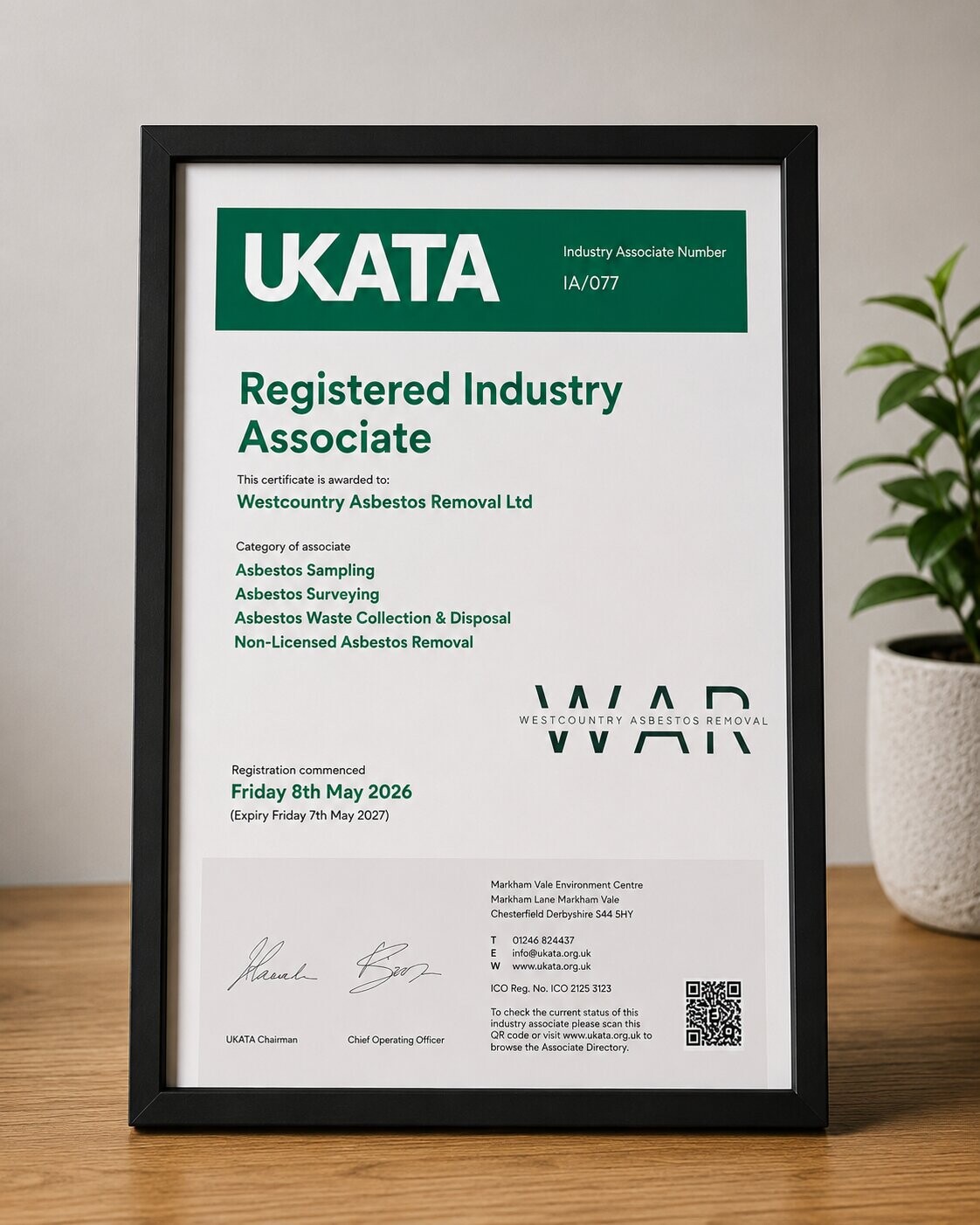
At West Country Asbestos, we are proud to be a UKATA Industry Associate, demonstrating our commitment to maintaining recognised industry standards, ongoing training, and safe working practices across all non-licensed asbestos removal projects. Our team follows guidance issued by the Health and Safety Executive (HSE) and carries out all work in line with current UK asbestos regulations.
In the UK, higher-risk asbestos materials such as insulation board, pipe lagging, sprayed coatings, and friable products containing blue or brown asbestos must legally be handled by licensed asbestos contractors. These specialist contractors operate under stricter controls and licensing requirements due to the increased risk of airborne fibre release during removal.
Non-licensed asbestos materials, including asbestos cement sheets, roofing panels, garage roofs, gutters, flues, and other bonded products, may present a lower risk when intact, but they still require careful handling by trained professionals. Incorrect removal methods can still release hazardous asbestos fibres into the air, potentially creating long-term health risks. Choosing a contractor with recognised UKATA training helps ensure the correct procedures, protective equipment, and controlled removal techniques are used throughout the project.
Professional asbestos contractors will also carry out detailed risk assessments, prepare method statements, use appropriate PPE and RPE equipment, and follow strict waste handling and disposal procedures. These measures help minimise contamination risks, protect building occupants and workers, and ensure the area is left clean and safe upon completion. Clients also benefit from receiving the correct paperwork and documentation for their records and compliance purposes.
Ultimately, selecting a qualified and accredited asbestos contractor is about protecting health, maintaining legal compliance, and reducing unnecessary risk. By working with a trained and safety-conscious company such as West Country Asbestos, property owners and businesses can have confidence that non-licensed asbestos removal work is being completed responsibly, professionally, and to a high standard.
UKATA TRAINED OPERATIVES
NATIONWIDE ASBESTOS REMOVAL
Environment Agency registered
UKATA Industry Associate Certified

All asbestos-related work is carried out in full accordance with current UK legislation and HSE guidance, with a strong focus on safety, controlled removal procedures, and complete project documentation from start to finish. As a UKATA Industry Associate, West Country Asbestos is committed to maintaining recognised industry standards across all non-licensed asbestos removal works.
We specialise in non-licensed asbestos services, working with lower-risk asbestos-containing materials such as asbestos cement sheets, garage roofs, corrugated roofing panels, gutters, flues, soffits, and other bonded products where fibres are securely encapsulated within the material and can be safely managed using controlled removal techniques.
Asbestos is generally divided into licensed and non-licensed categories depending on the level of risk presented by the material. Higher-risk asbestos products, including pipe lagging, insulation board, sprayed coatings, and materials containing blue or brown asbestos, must legally be handled by licensed asbestos contractors due to their friable nature and increased potential for airborne fibre release. Our services focus specifically on non-licensed asbestos removal, providing a safe, compliant, and practical solution for domestic, commercial, agricultural, and industrial properties.
All work is undertaken by a team trained to UKATA standards and aligned with current Health and Safety Executive guidance, ensuring professionalism, consistency, and safe working practices throughout every project. Appropriate PPE, controlled handling methods, and compliant waste disposal procedures are followed at all times to minimise risk and maintain site safety.
Asbestos Removal & Testing: Common Questions
How do licensed and non-licensed asbestos materials differ?
Asbestos materials are classified depending on how easily fibres can be released. Licensed materials are typically higher-risk and include friable products such as insulation, sprayed coatings and pipe lagging, often associated with blue (crocidolite) or brown (amosite) asbestos. Non-licensed materials are generally more stable, such as asbestos cement sheets, roofing panels and flues, where fibres are bound within the material and present a lower risk when handled correctly.
Is it permitted to remove asbestos without holding a licence?
Certain asbestos materials can be removed legally without a licence, provided the work involves lower-risk, non-friable products such as asbestos cement. However, the work must still be carried out by trained individuals following strict safety procedures and current HSE guidance to ensure risks are properly controlled.
Which types of asbestos materials do you handle?
We focus on the safe removal of non-licensed asbestos materials, including bonded products such as roofing sheets, panels, flues and similar items. If materials are identified that fall under licensed work, we will provide clear guidance and ensure the appropriate specialist route is followed.
Will I receive documentation once the work is complete?
Yes, once the removal process has been completed, we issue a self-certification statement of cleanliness along with supporting documentation. This confirms that the work has been carried out safely and in line with current regulations, providing a clear record for homeowners, landlords and businesses.
Do you offer asbestos testing or surveys?
Where required, we can organise asbestos testing and surveys through trusted partners. Testing is used to confirm the presence of asbestos, while surveys help determine its location, condition and associated risk before any work begins.
Will the work attract attention on site?
We appreciate that privacy can be important. If needed, our team can attend using unmarked vehicles and carry out the work in a professional and considerate manner to minimise visibility and disruption.
How is asbestos waste handled after removal?
All removed asbestos is securely packaged, clearly labelled and transported to authorised disposal facilities in accordance with UK hazardous waste regulations. This ensures it is managed safely from removal through to final disposal.
Professional Asbestos Testing, Surveys & Removal in Exeter
Documentation & Certification for Future Property Sales
Following completion of any asbestos removal work, we provide a self-certification statement of cleanliness along with all relevant documentation. This confirms that materials have been handled and removed in line with current UK guidance, giving you a clear record of the work carried out.
Having the correct paperwork in place can be particularly important if you plan to sell your property in the future. It provides reassurance to buyers, surveyors and solicitors that any asbestos has been dealt with properly, helping to avoid delays or additional queries during the conveyancing process.
Our documentation is designed to give you confidence long after the work is complete, acting as evidence that the site has been left in a safe condition and that all work has been carried out responsibly and in accordance with recognised standards.
Additional Asbestos FAQs
Where is asbestos most commonly found in UK properties?
Asbestos can be found in a wide range of building materials, particularly in properties built before the year 2000. Common locations include garage roofs, soffits, pipe insulation, ceiling tiles, floor tiles, insulation boards and textured coatings such as Artex.
Is all asbestos dangerous if left undisturbed?
Asbestos-containing materials are generally low risk if they remain in good condition and are not disturbed. The main risk occurs when materials are damaged or worked on, which can release fibres into the air.
Can asbestos be safely left in place?
In some situations, asbestos can be managed rather than removed, particularly if it is stable and unlikely to be disturbed. If there is a risk of damage or planned work nearby, removal is usually recommended.
How old does a building need to be to contain asbestos?
Asbestos was widely used in UK construction until it was banned in 1999. Buildings constructed or refurbished before this time may contain asbestos materials.
What should I do if I suspect asbestos in my property?
Avoid disturbing the material and arrange professional testing or a survey. This will confirm whether asbestos is present and help determine the safest course of action.
Can asbestos be identified by sight?
No, asbestos cannot be reliably identified by appearance alone. Laboratory testing is required to confirm its presence and type.
Why is asbestos testing important?
Testing ensures materials are correctly identified, allowing risks to be assessed and the appropriate action to be taken. This helps prevent unnecessary exposure and ensures compliance with regulations.
Asbestos Removal Branch Areas
- Asbestos Removal Broadclyst
- Asbestos Removal Devon
- Asbestos Removal Dunchideock
- Asbestos Removal Ebford
- Asbestos Removal Exeter
- Asbestos Removal Exminster
- Asbestos Removal Exmouth
- Asbestos Removal Farringdon
- Asbestos Removal Ide Exeter
- Asbestos Removal Marsh Barton
- Asbestos Removal Matford
- Asbestos Removal Pathfinder Village
- Asbestos Removal Shillingford Saint George
- Asbestos Removal Sowton
- Asbestos Removal Stoke Hill
- Asbestos Removal Topsham
- Asbestos Removal Woodbury Salterton


Proud to work with the following organisations…