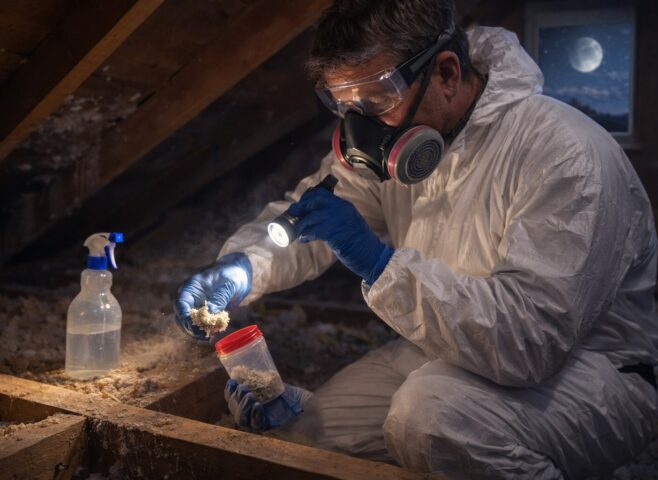
Garages, workshops, sheds and other outbuildings are often renovated with less preparation than the main home. Yet older roofs, wall panels, ceilings and service areas may contain asbestos products that should be identified before drilling, cutting or demolition begins.
For property owners in Exeter, an early asbestos check can prevent an apparently simple improvement from becoming an unexpected safety problem. It also gives builders clear information before they price and schedule the work.
Why outbuildings deserve careful attention
Many garages and workshops were built using durable, inexpensive sheet materials. Asbestos cement was commonly used for corrugated roofing, flat panels, gutters, downpipes and wall cladding. Other asbestos-containing products may appear around heaters, electrical equipment, ceilings or pipework.
Weathering can make external products brittle, while years of fixings and repairs may leave cracked edges. Even when a panel appears stable, power tools or careless removal can create dust and breakage.
Testing should come before intrusive work
Visual appearance cannot reliably confirm whether a product contains asbestos. A competent professional can assess suspect materials and take controlled samples for laboratory analysis where appropriate.
The result gives the project team evidence rather than assumptions. Our guide to asbestos testing and removal in Exeter explains how identification informs the next stage of planning.
Consider the full renovation scope
A garage conversion may involve more than removing a roof. New wiring, insulation, windows, drainage and internal linings can disturb several parts of the structure. The assessment should therefore consider every area affected by the proposed work, including hidden layers and service routes.
Share the survey or sampling information with the designer and all contractors. If asbestos remains in an area outside the immediate project, record its location so later maintenance does not disturb it unknowingly.
Management may be possible in some cases
A positive result does not automatically require immediate removal. Sound asbestos-containing material that will remain undisturbed may sometimes be managed, labelled and checked periodically.
However, renovation often changes the risk because fixings, cutting or demolition are planned. Removal or encapsulation may be necessary when the material is damaged, deteriorating or directly affected by the new design.
Use the correct removal controls
The material type, condition and work method determine whether a licensed contractor is required. Some lower-risk asbestos cement work may be non-licensed, but it still needs trained workers, controlled handling, suitable protective equipment and lawful waste disposal.
Before appointing a provider, read about licensed and non-licensed asbestos removal. The contractor should explain the applicable work category and the controls included in the quotation.
Avoid breaking sheets unnecessarily
Where removal is required, intact sheets should generally be handled in a way that minimises breakage and dust. Materials must be appropriately wrapped or bagged, labelled and transported by an authorised carrier to a suitable facility.
Attempting to smash panels into smaller pieces for transport can increase fibre release and contaminate nearby surfaces. Our article on why you should never remove asbestos yourself outlines the wider risks of an improvised approach.
Plan for neighbours and shared access
Outbuildings are often close to gardens, paths, neighbouring properties or shared driveways. The work plan should consider exclusion zones, access routes and how packaged waste will be moved without affecting occupants or the public.
Good communication is particularly important when a garage adjoins another building or sits on a boundary. Neighbours do not need unnecessary alarm, but they should not be exposed to avoidable dust or uncontrolled debris.
Keep documents with the property record
Retain laboratory results, the contractor’s plan, waste consignment notes and any clearance information. These documents show what was tested and removed, and whether asbestos remains elsewhere in the structure.
Accurate records are valuable when the property is sold, when further work is planned or when a new contractor needs to understand the building.
Make the asbestos question an early decision
Garage and outbuilding renovations can be straightforward when hidden risks are identified before work starts. Testing allows the design, quotation and programme to reflect the actual materials present.
If an older outbuilding in Exeter is due for conversion, repair or demolition, keep suspect materials undisturbed until competent advice is available. A planned assessment is safer and usually far less disruptive than discovering asbestos halfway through the job.