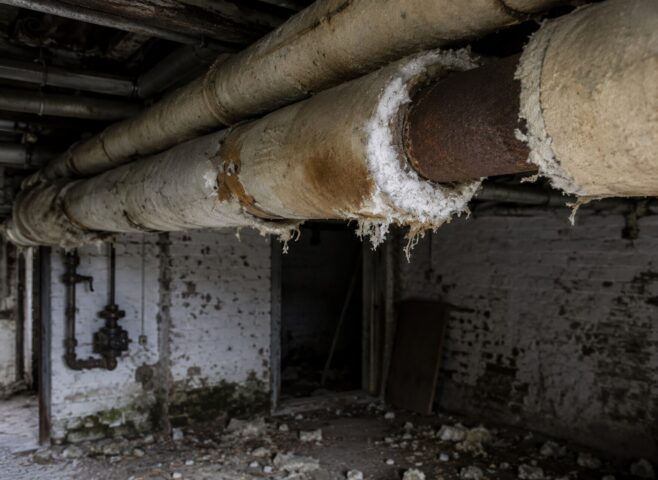
Older Exeter properties often contain hidden asbestos materials above ceilings, behind boards and around service routes. If you are planning to refit a kitchen, the work may involve removing ceiling panels, moving light fittings, chasing walls or opening boxing around pipes. These tasks can disturb asbestos-containing materials if they are present, even when the surface looks sound and ordinary.
Testing before work starts gives homeowners, landlords and contractors a clearer basis for planning. It helps identify whether suspect materials need to be left alone, managed in place or removed by a competent specialist. A sensible survey can also prevent a kitchen project being stopped halfway through because an installer discovers an unexpected board or textured coating.
Why kitchen ceiling work can create a risk
A kitchen refurbishment often combines several trades in a small area. Electricians may remove fittings and cut access points, plumbers may alter pipework, and installers may fix cabinets or extractors into walls and ceilings. Older ceiling finishes, insulating boards, soffits around pipes and panels used for fire protection can all be relevant, particularly in buildings constructed or refurbished before asbestos use was widely restricted.
Asbestos is not dangerous simply because it exists in a building. The concern arises when fibres can be released and breathed in. Drilling, sanding, cutting, scraping or breaking a suspect product can turn a previously stable material into a source of contamination. The difficulty is that asbestos cannot be confirmed reliably by appearance alone, and a modern-looking kitchen may still have older layers concealed behind later finishes.
What an asbestos test can establish
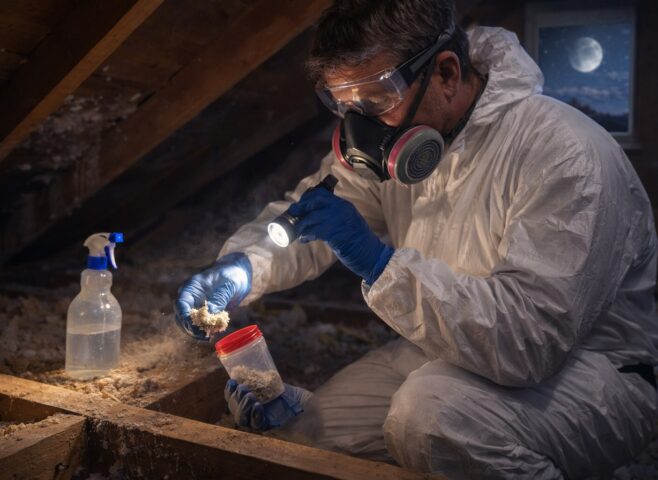
A qualified surveyor or asbestos professional can identify materials that should be sampled, take representative samples safely and arrange analysis by a suitable laboratory. Depending on the planned work, the assessment may consider ceiling boards, textured coatings, partition panels, pipe insulation, service risers and any older materials that the refurbishment will disturb.
The result should be read alongside the scope of work. A negative result for one ceiling layer does not automatically clear every nearby material. Conversely, a positive result does not always mean the entire kitchen must be stripped out. The practical response depends on the material, its condition, how firmly it is bonded, the planned disturbance and whether the work can be redesigned to avoid it.
Planning the test around your refurbishment
Arrange testing while the kitchen design is still flexible. Give the surveyor details of the intended changes, including new lighting, extractor routes, boiler or pipe alterations, ceiling repairs and wall openings. This helps the inspection focus on the places where trades are most likely to drill, cut or remove material rather than treating the room as a collection of isolated surfaces.
It is also worth checking related areas before contractors arrive. If a ceiling connects to a utility room, loft space or hallway, the same older material may continue beyond the kitchen. Previous posts on testing an older bedroom ceiling and opening up an older loft explain why connected spaces should not be overlooked when work crosses boundaries.
What to do if asbestos is identified
If a sample confirms asbestos, pause the affected activity and keep people away from the area until the next step is agreed. Do not sweep dust, use a household vacuum or attempt to scrape the material back yourself. Tell every contractor who may work nearby and provide them with the relevant survey information so that the refurbishment plan can be adjusted before anyone resumes.
Some materials may be suitable for careful management in place, with the kitchen layout changed so they are not disturbed. Others may require controlled removal, especially when they are damaged or directly in the path of new services. For context, testing before removing an older utility room shows how an apparently straightforward room alteration can involve several hidden building components.
A safer start for an Exeter kitchen refit
Testing is most useful when it is treated as part of project planning rather than an emergency response. It can give the designer and tradespeople a defined set of boundaries, reduce uncertainty around quotations and make it easier to schedule any specialist removal before the main installation team arrives. Keep the report with the property records so future repairs do not begin from the same lack of information.
If your Exeter kitchen is in an older property and the refurbishment will disturb ceilings, panels, coatings or service routes, arrange professional asbestos testing before work begins. Do not rely on age, appearance or a previous owner’s reassurance. A properly planned assessment is a practical way to protect occupants, tradespeople and the rest of the renovation.