Loft conversions and roof repairs can transform an older Exeter property, but the first stage should be understanding what is already hidden above the ceiling. Homes and commercial buildings constructed or refurbished before the year 2000 may contain asbestos in textured coatings, insulation boards, cement sheets, old water tanks, pipe insulation or other building products. These materials are not always obvious from a quick visual check, and disturbing them during a loft project can release hazardous fibres.
Why loft work can disturb asbestos
Opening a loft usually involves more than laying boards and adding insulation. Contractors may need to remove sections of ceiling, move services, alter roof timbers, cut through partitions, install dormer windows or create new access through a landing. Each activity can affect materials that have been in place for decades. A grey board behind a knee wall, a sprayed coating on a beam or an old corrugated panel may look like ordinary construction material while behaving very differently when drilled, sawn or broken.
Even small preparation jobs deserve care. Running electrical cables, fitting downlights, replacing a loft hatch or taking down an old water tank can create dust in a confined space. Loft areas are difficult to ventilate and often contain settled dust, so a seemingly minor disturbance can spread contamination into the rooms below. Testing before work begins gives the homeowner and contractor a clearer basis for deciding what can remain, what needs managing in place and what requires controlled removal.
What an asbestos survey or test can establish
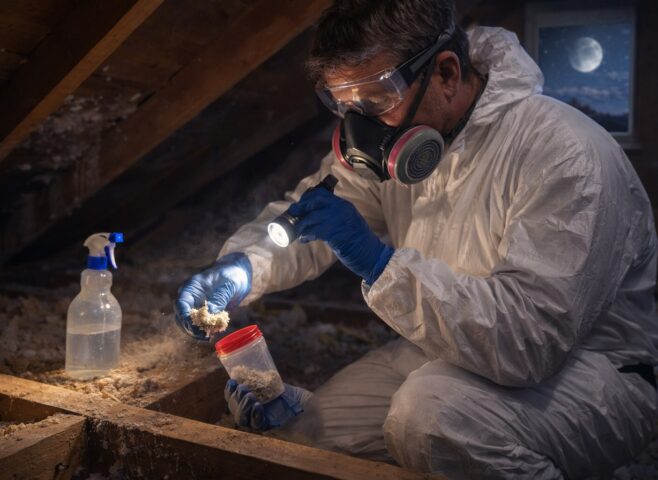
The appropriate assessment depends on the proposed work. A refurbishment survey is designed to locate asbestos-containing materials that may be disturbed during a defined project. Where the work is more limited, targeted sampling may answer a specific question, such as whether a ceiling coating, board or insulation product contains asbestos. A competent surveyor will consider the building’s age, construction, planned alterations and the condition of accessible materials rather than relying on appearance alone.
Sampling should be planned so that it does not create a new risk. The material, its location and its condition should be recorded, with samples taken using suitable controls and sent to an appropriate laboratory. The result is not simply a yes-or-no label: the location, extent, surface condition and likelihood of disturbance all help determine the next safe step. If suspect material is damaged, inaccessible or likely to be affected by structural changes, further advice may be needed before the loft design is finalised.
How test results affect the project plan
A positive result does not automatically mean that every loft project must stop. In some cases, asbestos can be left undisturbed and clearly recorded, with the work redesigned around it. In other cases, removal or professional encapsulation may be necessary before the contractor can proceed. The important point is that this decision is made before trades begin, not after a drill has already gone through a board or a ceiling has been stripped.
Test information should be shared with everyone involved in the job. The builder, electrician, roofer, insulation installer and waste contractor each need to understand which areas are restricted and which controls apply. Keeping the report with the project documents also creates a useful record for future maintenance. If the property is sold or another alteration is planned later, a clear asbestos record can prevent repeated uncertainty and reduce the temptation to investigate materials casually.
When professional asbestos removal is required
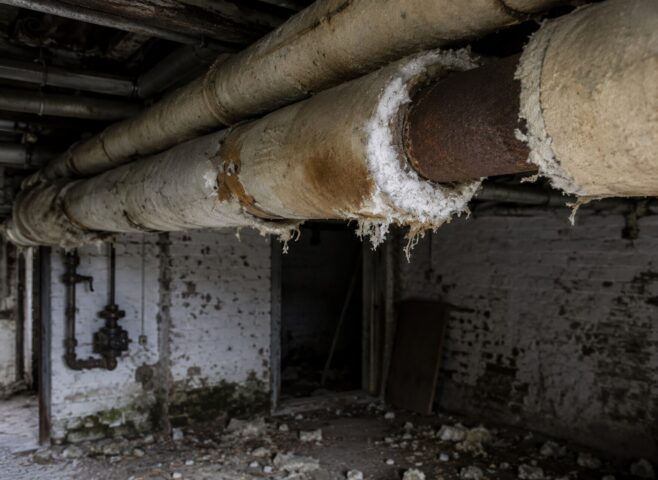
Where asbestos-containing materials must be removed, the work should be planned by contractors with the correct training, equipment and disposal arrangements. The approach depends on the type of product and its condition. Asbestos cement, insulation board and lagging do not present identical challenges, and a loft with fragile or damaged materials may require more extensive controls than a clean, accessible cement panel. Waste must also be packaged and transported through the proper route rather than placed in a household or ordinary building-waste bin.
For homeowners, the safest practical rule is simple: do not cut, sand, scrape, drill or sweep suspect loft materials while waiting for a result. Close off the area where possible, keep other people away and tell the project manager exactly what has been seen. If the property has already been disturbed, avoid further cleaning that could spread dust and seek specialist advice. Early action is usually easier to organise than dealing with contamination after a refurbishment has started.
Arrange testing before the first tool goes in
Planning a loft conversion, roof alteration or new electrical installation in an older Exeter property is the right time to arrange asbestos testing. A clear result helps designers specify work accurately, gives contractors information they can act on and protects occupants from avoidable exposure. For related guidance, see our advice on testing before removing an older Exeter outbuilding, testing before replacing an older Exeter roof and testing before opening up walls in an older Exeter property. These decisions are easier and safer when made before the project reaches the demolition stage.