Evening & Weekend Asbestos Testing in Exeter and Across Devon
At Westcountry Asbestos Removal, we’re proud to announce that we now offer evening and weekend asbestos testing appointments in Exeter and across Devon.
We know that arranging asbestos testing during standard working hours isn’t always practical. Many homeowners work full time, landlords manage occupied properties, and businesses can’t afford daytime disruption. Our new out-of-hours asbestos testing service is designed to solve exactly that problem.
Local Asbestos Testing That Fits Around Your Schedule. Our evening and weekend service is ideal for:
- Homeowners in Exeter and Devon who can’t take time off work
- Landlords and letting agents needing testing outside tenant hours
- Commercial premises that operate Monday to Friday
- Refurbishment and renovation projects working to tight deadlines
Professional Asbestos Surveys – Evenings & Weekends
Choosing an out-of-hours appointment doesn’t mean compromising on quality. Every asbestos test is carried out to the same high standards, regardless of timing.
Our service includes:
- Qualified and experienced asbestos surveyors
- Safe and controlled asbestos sampling
- Analysis by UKAS-accredited laboratories
- Clear written asbestos reports
- Honest, practical advice if asbestos is found
From asbestos cement sheets and garage roofs to artex ceilings and insulation materials, we carry out reliable testing for both domestic and commercial properties.
Asbestos Testing: FAQs
What does asbestos testing actually involve?
Do I need to leave my property during asbestos testing?
How long does asbestos testing take?
Is taking a sample dangerous?
What materials are commonly tested for asbestos?
What happens if asbestos is found?
Can asbestos testing be done in the evening or at weekends?
What Is Involved With Asbestos Testing?
Asbestos testing is a careful, methodical process designed to determine whether a material contains asbestos and, if so, how risky it might be. It is not simply a case of “looking at something and guessing.” Proper testing follows a clear chain of steps that balances accuracy with safety, because disturbing asbestos without the right controls can release dangerous asbestos fibres into the air. In most cases, asbestos testing is carried out by a trained surveyor or analyst who understands both the science of asbestos and the practical realities of working in homes, workplaces, and industrial environments.
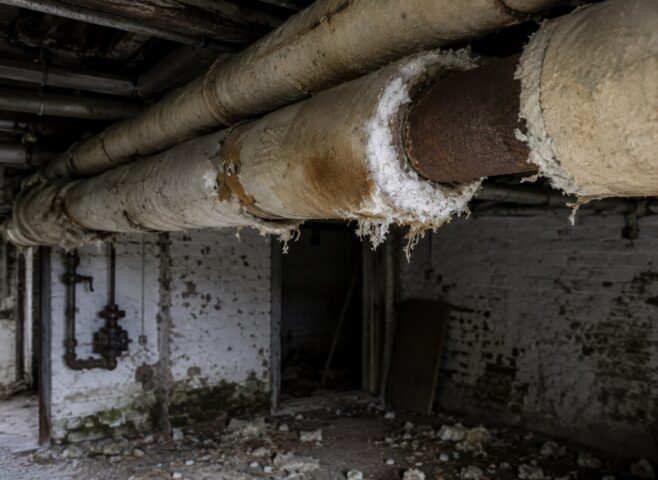
The process usually begins with an initial assessment of the site. Before any samples are taken, the surveyor will visually inspect the area and identify materials that are commonly associated with asbestos, such as textured coatings, insulation board, pipe lagging, floor tiles, or cement products. This stage is important because it helps determine where sampling is necessary and what level of precautions should be used. The surveyor will also consider factors such as the age of the building, the condition of the materials, and whether the area is occupied or likely to be disturbed.
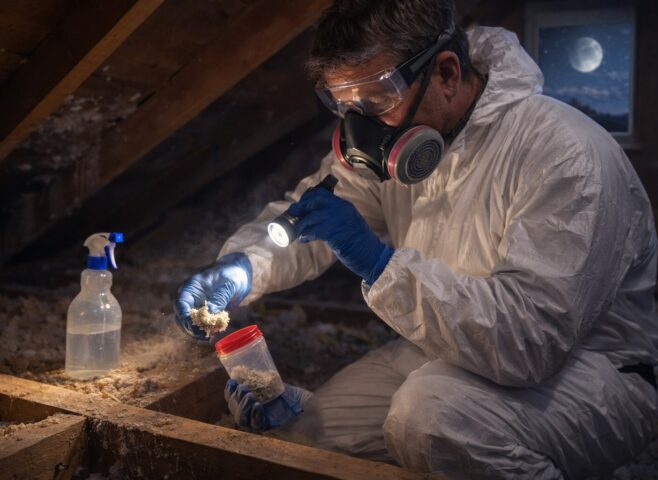
Once potential asbestos-containing materials have been identified, the next step is to collect a physical sample, known as a bulk sample. This is typically a very small piece of the material, often no bigger than a pea. To minimise risk, the surveyor will usually wear disposable coveralls, gloves, and a suitable P3 respirator mask, and may dampen the material slightly before sampling to reduce the chance of asbestos fibres becoming airborne. The sample is then carefully placed into a sealed, clearly labelled container or bag to prevent contamination or exposure.
After sampling, the disturbed area is usually made safe again. This may involve applying a small amount of sealant or tape to the spot where the sample was taken, ensuring that no loose fibres remain exposed. The surveyor will also ensure that the surrounding area is left clean and safe for normal use, so occupants are not put at unnecessary risk.
The collected samples are then sent to a UKAS-accredited laboratory for analysis. In the lab, specialists use polarised light microscopy or other approved techniques to examine the material under high magnification and confirm whether asbestos is present, and if so, what type. This part of the process is critical, because different types of asbestos can carry different levels of risk and may influence how the material should be managed or removed.
Finally, the results are compiled into a formal asbestos testing report. This document will clearly state whether asbestos was detected, what type it is, where it was found, and what recommendations are made. Depending on the findings, the report may advise that the material is safe to leave in place if it is undisturbed and in good condition, or that further action such as encapsulation, management, or professional removal is required.